I did not enjoy A Gate at the Stairs by Lorrie Moore. I really thought I was going to love this book, so I was disappointed. I'll get to it's faults in a minute, but I will say that despite ending up not liking it, there were a few good things. First, I read it all in one day, quickly, so it was obviously interesting enough to keep me from dropping it for something else. Moore's writing style does pull you in and flows well, and you feel like you just dropped in for a year in the life of the main character, Tassie. I also think she does a wonderful job with writing realistic dialogue. Her characters talk over each other, interrupt, miss each others' points, steer the conversations in new directions, repeat themselves. They sound like realy people. I believe that's one of the main reasons why this book was been well reviewed for the most part.
However, the plot holes were astounding! And none of the characters were likable. They weren't just like real people who have faults that you might not like, they were just all-around not likable. It made it hard to care what happens to them.
Part of the reason I didn't like the characters is because they were all liberals, the really stupid kind of liberals. Moore really isn't flattering in describing them, which I found odd since I'm sure she's liberal herself, as are most of the people who review books. For example, one of the main issues in the book is about adoption. It addresses the fact that most white people don't want to adopt black babies. A white couple in the story announces that they don't care about all that and starts the process to adopt a biracial girl, and then they hire Tassie to babysit. The couple starts a group for biracial families. When this group gets together, they sound like a bunch of total idiots and never do anything. Eventually, the couple seems to think it's too much trouble for them to have this biracial daughter, that they shouldn't have done it. This story bothered me on two levels. First, the way adoption was written about in general was very unflattering, enough that if someone read this when they were considering adopting it could easily push them away. Second, it definately made it seem like a bad idea to adopt children of other races, although at the same time it lectures people on wanting to adopt babies from China before they'd adopt a black baby from the same town. It wanted it both ways. You're racist if you don't want the black baby, but then you're doing it wrong if you adopt it and you're white. So you just shouldn't adopt at all? We should just abandon the black babies if there aren't enough black families willing and able to adopt? I'm not sure that's what her point was, but that's how it came across.
It also portrayed liberals as a bunch of snobs, oddly enough: "This was the sort of snobbery I noticed even among the most compassionate Democrats." One of liberals serves endangered species in her restaurant. She justifies this by saying if people want to eat them, they'll try to save them. What kind of sense does that make? And how was she able to serve them up anyway? Shouldn't that be illegal? She also says racist things, such as "Correct subject-verb agreement is best when children are learning language, so be careful what you sing. It's an issue when raising kids of color. A simple grammatical matter can hold them back in life." As though this is only an issue in people of color? They're so stupid that teaching them a silly kids song will stunt them for life, but it's not a issue with white kids?
SPOILER ALERT:
Okay, about the plot holes. The worst one centers around the family Tassie babysits for. A "shocking" secret is revealed toward the end, but it's completely obvious that they murdered someone from comments made throughout the book, so it's not surprising when you get to it. And what actually happened was so stupid and didn't even make sense, that I found myself laughing at the fact that this was actually printed and not fixed by an editor or something that it wasn't even remotely sad. The couple used have a child, who was driving them crazy in the car one day when he's 4. They stop the car on a toll highway and make him get out. Okay, they scared him, whatever. But then they drive off! First of all, who would do that? Secondly, they immediately panic, but for some reason now can't stop even though they stopped two seconds ago. The wife actually starts yelling at the husband to stop before they even had time to actually move at all. But for some reason now, they can't stop and have to go up forever before they can turn around and come back, and the kid ends up getting hit by a car. How stupid is that? The way it was written didn't even make any sense. I was trying to follow it and make it make sense instead of caring about what was happening. Ugh.
And, one of the other main points in the story is that this all takes place right after 9/11. Yet none of the characters care. When Tassie's brother mentions joining the military, she's all, "well, at least it's peacetime." What? Who thought that in first few months after 9/11? And it's totally shocking to everyone when he dies. Like that's not a possibility when someone goes off to war. I remember that year, and I was the same age as Tassie is in the book - 20. I didn't forget about it two days later. I didn't think it wasn't a big deal when friends and family members joined the military. I was a lot more supportive than her family was, but I didn't act like it didn't matter. And most of the people who joined up that year didn't do so for the college tuition. They did it because of 9/11. Her brother does it because his grades were bad and this will pay for college, and everyone thinks it horrible that he dies because he was just trying to get tuition money. What, do they think the military is just a work study problem? That there should be no risk of dying? What is wrong with these people?
And Tassie's stupid enough during all of this to date this "Brazillian" guy who turns out to be Arab, and probably a terrorist. She's too stupid to realize that he's actually Arabic and that doesn't like her much, and they make jokes about 9/11 and the war and things, jokes that no one I know would have made that soon afterward. And she does nothing when he abruptly sells everything in his apartment and tells her not to tell anyone about him if they ask. There were about a million signs of him being about to do a suicide bombing or something and she does nothing.
Sunday, November 29, 2009


Sunday, November 15, 2009
Stolen Innocence
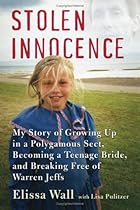
Stolen Innocence, an autobiography by Elissa Wall with Lisa Pulitzer, will make you angry. It made me furious. It made me want to do something to protect these girls, although I don't know what that would be.
Stolen Innocence is about Elissa's life in a polygamous sect, the Fundamentalist Church of Jesus Christ of Latter Day Saints (FLDS). It starts off simply odd, with an inside look at growing up in a house with two mothers and two sets of children (eventually a third wife joined them). It details the conflicts and frustrations from such a living arrangement. That's interesting enough, but eventually due to their belief that the world would end on Y2K, the family moves to an FLDS exclusive community. They were secluded before this, but now they have no access to the outside world. The schools, the police, everything is run by the FLDS. As Warren Jeffs taken control of the group, the restrictions on the community become increasingly strict. Elissa's mom and her siblings are reassigned to another man when her father is deemed unable to control them. From that point, this new man is their father. They cannot question anything, or have any worldly influences. There is no TV, no radio, no non-FLDS sanctioned music or books. They are only taught religion in school. They are taught that they will go to hell if they disobey or do not listen to the prophet, who Warren Jeffs is speaking for and later becomes.
Despite these rules, some of the boys do question what is happening. When they do so, they are banished, becoming apostates whom they believers can no longer have any contact with without facing banishment themselves. This ends up happening to all of Elissa's older brothers. They even have to leave one on the side of the highway.
When Elissa is 14, she is forced to marry her 19-year-old cousin. She fights this decision, but no one will listen. Her mother and sister do try to plead her case to Warren, but he refuses and tells them they must encourage Elissa to go through with it or they're putting their own salvation at risk. Elissa considers leaving, but has no money, no real education, no contacts, nothing. She also has been so brainwashed that she believes running away will condemn her to hell. She is forced to go through with it. Until this point, she has never heard words such as "sex" or "rape" and has no idea about anything related to sex or that anything other than sleep happens in a married couples' bed. She has been taught that even the most innocent touching from the opposite sex is wrong and has also worn for concealing clothing. Now suddenly she's married and her husband expects sex. He explains nothing to her, just forces himself on her. She tries to tell her mother what's happening, but she won't help her. She goes to Warren and tells her everything, but he just yells at her for coming to see him without her husband.
There is much, much more to this story, so please don't let this synopsis lead you to believe you know the whole story. Read this book. Learn about Elissa's story. There are many scenes that are difficult to read. Her "husband" repeatedly raping her is awful to read about, especially before she realizes that this is something they're supposed to be doing to create babies. I want to reach out and strangle her mother for sitting back and watching this happen. Elissa is very forgiving to her mother, but I can't be. What kind of mother let's that happen to their child? And she has two younger daughters that the same thing could happen to, and she does nothing. I know that she was brainwashed, but so was Elissa, and she managed to do something about it eventually. I don't understand how at some point you don't question authority, realize that what they're doing is wrong.
And yet, I've seen people act like that on much smaller scales all the time. They don't ask questions. I remember one time at church, during my senior year when we were in between pastors, we had John Carl Davis serve as either an interim pastor. He blatantly misrepresented scripture and took things out of context. He also made this bizarre proclamation that the youth, who usually sat in a group together around the middle of the pews directly in front of the altar, should start sitting in this other section, off to the side. And people just did it! Without asking why or having any sort of basis for this decision. I was shocked. I was the only one who stayed in the original section, refuses to move or sit with my parents. I had people come tell me they couldn't believe my behavior and that I needed to move, lecturing me on my bad behavior. Not one of them could tell me why I needed to move except that Davis said so. Now, one could surely argue that my stubbornness was a sin, and that's fine. But I think everyone else blindly following is far worse, far scarier, far more threatening. What else would the blindly follow without questioning? How real is your faith when you only do what you're told without examining anything for yourself? I know this is a very small example, but I can see how going with the small things for a while can eventually turn into going with the big things, which is what happened with the FLDS.
Always question. Always try to find out the truth. Always ask why. Don't blindly follow someone just because they're in a position of authority. I am moved by Elissa's story and hope that I will always have the courage to stand up for what is right.
Saturday, November 14, 2009
Philly Firsts

I bought Philly Firsts by Janice Booker while I was on a business trip to Philadelphia. I went in a day early to sight see, which was wonderful. I loved seeing all of the historical sites. I actually finished this a while ago, but keep forgetting to post about it for some reason. It was a great choice for a souvenir. It talks about all of the many firsts that Philadelphia had.
Here are a few of my favorites:
First U.S. flag (I got to see the outside of the Betsy Ross)
First Mother's Day celebration
First merry-go-round
First fire department
First insurance company
First advertising agency
First marketing college course (so I have Philly in part to think for my job)
First copy of the Declaration of Independence
First book published
First electric TV demonstrated
First hospital
First cancer research
First ice cream in the U.S.
First carbonated beverage
First Girl Scout cookies
First bubble gum
First Baptist church (who oddly enough called themselves Pennypack Baptist Church, not First Baptist Church)
First computer
First discovery of electricity
That's a lot of firsts! And, that's only a few out of the book. Whew! It must be interesting to grow up in a place like that, with so much history right down the street. Can you imagine getting to go on school field trips to see the Liberty Bell or Independence Hall? You don't have a lot of options like that in Oklahoma. I love living here though, don't get me wrong. But it seems I also have Philly to blame for making me fat and lazy. A lot of junk food, books, TV, and the computer. Not good Philly, not good. I'm going to go eat some ice cream in front of the TV now!
Made from Scratch

Sandra Lee's memoir, Made from Scratch, was much more interesting than I thought it would be. She had a very rough childhood. The way she comes off on her TV show, she seems like someone who has also had an easy life. I'm not sure what it is exactly, but she doesn't seem likes she's ever had real problems. That is definately not the case. Up until the time she was about six she was basically raised by her grandmother, who taught her the skills that she would eventually use to survive and then to make millions. Her mother and stepfather took her and her sister back when she was six. Things were never great, but they didn't get horrible until her stepfather left and her mother sank into a depression, and Sandra was left to run the household and take care of four siblings even though she was only 10. She cooked, shopped, cleaned, did laundry, and was a mother to her siblings. Her mother belittled her and insulted her. She eventually went to live with her father, where she encountered a new set of problems and eventually found herself on her own at 17. She took her ability to make crafts to local craft shows, and started raking in money. She developed a product line and ended up making millions by the time she was 25.
The story really teaches the power of hard work, and that if you put your mind to something you can succeed. I think it also spotlighted why there are a lot of famous people who had bad childhoods. They have more desire to succeed, more motivation, no risk in trying because they have nothing to lose. She also didn't have well meaning relatives trying to help by telling her she couldn't make it, parents advising her to take the safe and secure route.
It's not the most well written book in the world, but the story was interesting enough to make up for that. Learning about her background in crafts and home decorating also explains her tablescapes on her TV show. I think they're cute, but I've also thought they were a little odd. I understand now that that is where her passion started, in creating simple, inexpensive ways to decorate, so this is her way of still sharing that info even though she's doing a food show.
This book also served as reading a biography/autobiography for the Four-Month Reading Challenge and as a book from 2007 for the Countdown Challenge.
Thursday, November 12, 2009
The Guinea Pig Diaries

I adored The Know It All. I loved The Year of Living Biblically. The Guinea Pig Diaries? Not so much. It was disappointing. You can kind of tell he was writing it with three kids in the background wanting his attention. I'm impressed that he's able to write at all with three young boys, but it left the book feeling rushed. Since this book is about a series of experiments instead of one long one, that added to that feeling. Plus he reworked and expanded some of his magazine articles, which I think contributed to that as well.
Also, I had a moment of panic when I hit page 99. He's related to Cass Sunstein? What?!?! NOOOOOOOOOOOOOOOOOOOOOOOOOOOOOOOOOOOOOOOOOOOOOOO!!!!!!!!!!!!!!!!!! The horror! The horror! I actually let out a scream and that point and yelled "NO! DAMMIT!" Sadly, my husband is used to my talking to books and the TV and didn't ask me what was the matter until I said it a second time. At least Ryan understood why this was a problem. Now, I'm not stupid. I knew A.J. Jacobs was a liberal. Not a whacked out crazy one, but a liberal nonetheless. And I have a few relatives I'd rather not claim. But to be related to Cass Sunstein and be proud of out it? No, no. Not good. For those who don't know, Sunstein is one of Obama's many czars, or the Administrator of Information and Regulatory Affairs. Sunstein wants the government to stop recognizing marriage period. He thinks animals should have legal rights in court. (I'm all for stopping animal cruelty, but that just seems silly.) He thinks we should celebrate tax day. He not only supports gun control, he thinks we should ban hunting. And he thinks the government owns your body once you die and should be able to take your organs at will, unless you specify that you do not want to donate your organs. What?
He also made the gigantic mistake of comparing Obama with George Washington? Really? Washington would be appalled by Obama. He'd be appalled by the Republicans too, so don't just take that as a slam against democrats. His chapter on Washington did make me want to read more about him though. Like Jacobs, I've read a lot more about Franklin and Jefferson than Washington. But it takes an amazing man to turn down power, and he had the opportunity to take on absolute power and walked away. That's impressive.
I did enjoy this quote from the book though: "I'll be aloof and mysterious, like the pope or Willy Wonka."
I would recommend Jacobs other two books if you haven't read them, but skip this one.
Wednesday, November 11, 2009
A Lady Raised High

I'm embarrassed to admit it took me months to finish A Lady Raised High by Laurien Gardner. I think I started it in June. Clearly it was not the most riveting book I've ever read. I think a big part of that was that I've already read a lot of books about Henry VIII and Anne Boleyn. I'm a little obsessed actually. I've read probably 10 books and have watched several movies about them, along with The Tudors. So, I know the story already. It all started with Phillipa Gregory's The Other Boleyn Girl (the book was a lot better than the movie, as usual) and I moved on to histories by Alison Weir. So it's not entirely the author's fault I wasn't that interested.
But, I think another reason why I didn't stay interested is that it was told from the rather boring character of Frances, maid to Anne. Frances is plucked out of obscurity by Anne before she becomes queen after protecting her from angry villagers. She's raised high to being one of the Queen's ladies. You're supposed to care about Frances and her love story as well as Anne's, but Frances is stupid, boring, and unfailing devoted to Anne. She can't see Anne's fault and puts her own life in danger needlessly to try to help Anne. Which normally would be brave, but just seemed stupid in her case, because she was so naive about the whole thing and couldn't see that the court wanted to convict Anne.
Overall I would skip this one. Go for the Phillipa Gregory or try Jean Plaidy. Plaidy's writing can be a little harder to get through, but she's historically accurate and still writes a good story. Although, I'm still considering reading Plain Jane by Gardner since I already own it (bought them at a library book sale), so I guess that tells you it wasn't completely terrible. I suppose if I resell both of them to Half-Price Books though, I'll make my $.50 back and it's necessary to read it...
Tuesday, November 10, 2009
Baby Laughs

No, I'm not pregnant, nor am I going to become pregnant any time soon (or at least I hope not). I picked up Baby Laughs by Jenny McCarthy to research the novel I'm writing. Yes, I'm writing a novel. I'm trying to participate in Nanowrimo (National Novel Writing Month). I've only got about 5,000 words out of 50,000 though, so I need to hurry up. Anyway, this book is for research. I actually meant to get Belly Laughs, McCarthy's other book, but I grabbed this one instead. Probably because I was embarrassed to be hanging out in this section of the library, even though I know most people probably assume a woman of my age has a child and I have a wedding ring on. Oh well.
Anyway, this book was actually really enjoyable. I read it all in one sitting. It was really funny, as you can imagine being written by Jenny McCarthy. She talks about the first year of mommyhood. She's very honest, whether it's about her baby peeing in her mouth or covering himself in poop or her getting hemmorhoids and not wanting to have sex and feeling like a giant hairy leaky cow. Childbirth is kind of like the great leveler for women. Being rich or famous might get you a better hospital, but it's not going to take away the crappy parts of giving birth. At the same time, she was very clear that it was absolutely worth it and was the best thing she's ever done. I felt like she was actually a lot more persuasive at getting me to consider having children. She doesn't just list the nice stuff and make it sound perfect and easy. She's tells you all the crap and still says it's worth it. That's a lot more powerful to me, because then I didn't really have anything to counter with. When someone talks about the positives, I can whip out my negative list. But she already said all of those reasons, so I was left with no argument. I hope my Mom doesn't read this.
Subscribe to:
Posts (Atom)