Showing posts with label Biography/memoir. Show all posts

Saturday, February 27, 2010

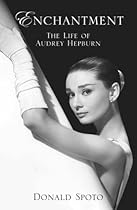
Enchanted


After reading High Society by Donald Spoto and loving it, I picked up Enchantment by him at the library. Enchantment is a biography of Audrey Hepburn, my favorite actress. Since I like Hepburn even more than I like Grace Kelly and I enjoyed Spoto's work, I expected to love Enchantment. But I didn't. Maybe I set it up for failure by expecting too much, or maybe I just lost interest because I was already familiar with Hepburn's life.
My now husband, then boyfriend bought me a book on Hepburn for my birthday the first year we were dating. It's full of beautiful photos and her basic life story. Since it was more about photos, I expected to find out more information from Spoto's book, but I don't feel like I learned much new information, and most of what was new to me was negative. I knew Hepburn had relationships with a few costars such as William Holden, but the book was rather full of affairs and failed relationships. Those were discussed in a rather unflattering manner. I felt like Spoto put Grace Kelly up on a pedestal and tried to knock Hepburn down a bit.
I did enjoy the first few chapters about her childhood. I knew she had suffered as a child during WWII, but this gave many more details than my glossy coffee table book did.
I surprisingly didn't enjoy reading about her movies as much. I think Spoto focused too much on some of the details around the movies that had nothing to do with Audrey to the point where my mind would wander and I would lose interest. I like getting a bit of behind the scenes info, but I felt like he just got off track a few too many times.
I am glad he praised my all-time favorite Hepburn movie, Paris When It Sizzles. It's hilarious, and it's the movie that made me fall in love with her. It doesn't get much press, and when it does it seems like people don't get that it's supposed to campy. She's wonderfully funny in the movie and encourage you to check it out if you haven't seen it.
But for this book, I think there are probably better biographies of Hepburn out there. Spoto has written a ton of old Hollywood biographies, and I will still pick up some of his about people he likes more, such as Alfred Hitchcock. Hitchcock came up frequently in both the Spoto books I read and you can tell Spoto worships him, so I think that would be a stronger book, as well as his biography of Marilyn Monroe. So, I still plan to pick those up some day.

Sunday, January 10, 2010

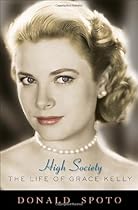
High Society: The Life of Grace Kelly


Even just knowing the basics about Grace Kelly's life - that she was a movie star who became a princess - you know she had one interesting life. So when I saw High Society: The Life of Grace Kelly by Donald Spoto on display at the library, I had to pick it up.
I don't normally read biographies, although I read a few last year and discovered I enjoy them. The only Grace Kelly movie I've seen is Rear Window, which is wonderful. You can't take your eyes off her when she's onscreen, even though Jimmy Stewart is also wonderful. So, I was excited about learning more about her life, and I wasn't disappointed.
This biography had all of the details I wanted, but not a lot of fluff. It's to the point, and is shorter than a lot of biographies appear to be, at 273 pages. It covers her entire life, although it focuses primarily on her time in Hollywood.
One of the things I was most surprised by was her battle against the movie studio. She had a contract with MGM, but fought them constantly about roles they were trying to force her to do, or not allow her to do, and her salary. Initially, she actually made a lot less than she did as a model, but became a very well paid actress by the end, compared to other actresses (although not well paid when compared to the actors she was working with). She seems like a very strong, determined woman who knew what she want and didn't want the studio controlling her. There's actually a lot of information in the book about how the studios worked back then, which I also found interesting. They were really in complete control of the actors, even dictating marriages and what they could wear off the set. Grace usually managed to get her way though, which is quite impressive. Spoto has written numerous old Hollywood biographies, and he seems to have a very good grasp on how everything worked back then, and he knew Grace personally, along with others who he interviewed about her, so his story seems very believable and accurate.
I also enjoyed reading about her relationship with Prince Ranier. They met as part of a ploy by the magazines to get stories and photos to sell of the Cannes film festival in 1955. They had just a 30-minute conversation, but that led to a seven-month letter writing relationship. They fell in love through these letters, then he came to the states to propose. How romantic is that? And very not Hollywood, even in those days. She then left everything here to go to Monaco and be a princess, which isn't as easy as it sounds. She had to adjust to living in a foreign country where she didn't speak the language and was viewed as an outsider. Most citizens didn't feel like a Hollywood actress was appropriate for a princess, and she didn't like many of the traditions they had, such as all women who came to visit her having to wear a hat, which she promptly changed.
I highly recommend this book if you like biographies, this period of history in Hollywood, or if you're just interested in a quick read about an interesting woman. It made me want to go watch her other movies right away, along with some of Spoto's other books.

Tuesday, January 5, 2010

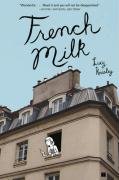
French Milk

I was disappointed when I received French Milk by Lucy Knisley in the mail. I had ordered it online and Amazon neglected to call it a graphic novel. The official review on the page mentioned it had photos and sketches, but I thought that would be in addition to the story, not the whole story. So, I wasn't very happy with this purchase. I'm not a big graphic novel fan. I did love Watchmen, but I've tried a few others but I just can't get used to the format. I tend to want to ignore the photos, which you can't do. So, take this review with a grain of salt.
Although the book was enjoyable, I felt like it lacked substance. There just wasn't any meat to it. I thought I would get to delve into life in Paris for a month, and Lucy's relationship with her mother. But it just skims the surface. And most of that surface involves smoking and drinking. She took up smoking just because she was going to Paris? Really? I also just found Lucy to be a bit annoying. I wanted to slap her upside the head and tell her "You're in Paris!!! Enjoy it! Quit whining!" She even tells herself that at some point.
Even though I'm being really negative, I do see how some people would enjoy it. If you know going in that it's a graphic novel, and don't expect to get travel tips from it, then you may actually enjoy it. And the cover is really pretty, so it looks nice on my shelf, which makes me feel a little bit better about the money I spent on it. I'd suggest getting it from the library instead of purchasing it.

Thursday, December 31, 2009

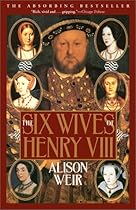
The Six Wives of Henry VIII

I normally read Alison Weir's book quickly, but it took me a while to get into The Six Wives of Henry VIII. I think I was just Tudored out. I've read a lot of books about Anne Boleyn over the last two years, watched the Tudors and a bunch of movies, read about Catherine of Aragon. So it took me a while to get through the first part of the book, the part about Catherine and Anne because I wasn't learning anything new. I wanted to finish all of my books I'm in the process of reading before the new year. I'm setting a goal to only read two books at a time next year, so I wanted to wrap up everything I'm in the middle of now.
Once I got the part of the book about Jane Seymour, my interest renewed. I'm really not that familiar with his later wives, so I enjoyed reaading about them and later part of Henry's life. I especially enjoyed reading about Anne of Cleves and Katherine Parr.
Anne of Cleves was his fourth wife, and his luckiest one. He simply divorced her, rather than beheading her or imprisoning her. Henry actually gave her three homes and plenty of money as part of the divorce. Anne was able to live in comfort and freedom for the rest of her life. Henry apparently thought she was ugly and wanted to get rid of her, but she was so amiable and well liked he did it nicely. He had heard of her great beauty and by the time he met her it was too late to back out. Apparently being nice and unattractive comes in handy once in a while. The most beautiful of his wives didn't fare so well.
I liked Katherine Parr because she was considered his most intelligent wife, and one of the most intelligent women of the time. She was Henry's last wife, and she was lucky in that he died before tiring of her. She was a very good stepmother to Mary and Elizabeth, more of a friend to Mary really since they were the same age (although they had a falling out later over religion). Weir notes that two of the finest minds of the time were molded by Katherine - Elizabeth I and Lady Jane Grey. Katherine was also instrumental in making it preferable for women to be educated. She promoted learning and scholarly pursuits in her court.
It's also interesting that out of his six wives, three were named Catherine. Makes it a little easier to remember. And two were named Anne. And his other wife and two daughters rounded out the names available - Jane, Mary and Elizabeth. It seems like pretty much every female had one of those names. And all of the men were Henry, Edward, or James. Makes it a bit confusing. It must be difficult to learn history in England. We Americans just have a few hundred years to learn of our country's history. English schoolkids have to learn 1500 years of history just of their country, with hundreds of people with all of the same names. It must be hard to try to remember if it was Henry the IV or V that did such and such. It just makes it that much sadder that most Americans don't know our own history, when it's not even that much stuff.

Tuesday, December 29, 2009

British Kings and Queens


Mike Ashley's British Kings and Queens provides a great overview of all of the kings and queens of Britain. I feel like I have a better overall grounding of the subject now, and can better place them in history now. Before, I had read about various monarchs, but not in sequence, so I would often get confused about who went where. There are far too many to remember them all, but this gives me a better chronology at least. It was also neat to follow the genealogy and think about the current royal family descending from all of these other people.
I was also struck by the fact that the two best times in England's history were when Elizabeth and Victoria reigned. I knew that before reading this, but it's really striking when you read about them in conjunction with all of the other ones. Both of them ruled over great empires, the two biggest points in England's history. Both also ruled over a united Britain, which was rare. There was also great literary and scientific movements during both times.
On the other hand, it's surprising how many of the monarchs were somewhat crazy. Maybe that shouldn't really be surprising. They all either were raised to believe they were better than everyone and were coddled and spoiled, or weren't raised expecting to rule and were thrown in to it unexpectedly and didn't know how to handle it. And there's the fact that they married their cousins and once you do that a few times you're bound to get a few crazies.
Since Ashley is British, it was interesting to get his take on George III, the king during the American Revolution. George III was apparently one of the crazies, although they now think that was due to a blood disease, not actual madness. The war is covered pretty quickly since that's not the point of the book, but it renewed my interest in finding a British history book about that time period. I'd love to see how they teach that war in England.
Overall, if you're looking for a great overview of the British monarchs, this is a great choice.

Monday, December 28, 2009

The Simpsons: An Uncensored, Unauthorized History


I love The Simpsons, so I was super excited when I saw The Simpsons: An Uncensored, Unauthorized History by John Ortved at the library. We have all 12 seasons that are out on DVD. The book is told in a unique way, consisting mainly of bits of interviews with people connected with the show, interspersed with commentary from the author. As a result, it doesn't read like a typical nonfiction book, which is a bit disconcerting at first but works really well overall for this book. Even if you're not a fan of the Simpsons, the book is a great commentary on the 90s and TV history during that time, and how creating an animated TV shows works.
The most surprising thing to me is how little Matt Groening has to do with the actual show. He created the concept and original sketches, but others really ran with it and fine tuned it, and did all of the actual writing. There was a lot of information about the writers. As a writer, that fascinated me, how the brainstorming and writing process works when you're working on a show and having to share writing duties. I also didn't realize that Conan O'Brien wrote for the show from 1991-1993. I guess that is actually the most interesting thing! He was the main writer for Marge vs. the Monorail and a few other episodes. That cracks me up. Ortved interviewed some of the people who worked with him at the time, and they talked about how shocked they were when he was chosen to do the Late Show since he was a writer. They all thought he'd be great because he was always entertaining them, but still. It's fun to think of him as a writer. And he named Selma's iguana Jub Jub. He used to make up silly commercials for a product called Jub, and they ended up naming the iguana after that in tribute to Conan. I was also surprised that most of the original writers all went to Harvard. I guess that's why a lot of the jokes are so smart in the first several seasons.
I loved that book talked so much about the 90s. For example, in 1990 the Teenage Mutant Ninja Turtles, New Kids on the Block, and The Simpsons were the three biggest merchandising product brands! I loved all of those back in the day. I was shocked that at one point, Bart t-shirts sold "at the rate of a million per day in North America." What? That's crazy! But remember when those Butterfinger commercials ran every commercial break and Bart was everywhere? I'd kind of forgotten just how popular he was.
It's also amazing to think about how many people have made guest appearances over the years. The writers talk about meeting Michael Jackson, and how weird that was, and how they were all trying not to look at his nose. And Tom Wolfe talks about he didn't even know about his first appearance. His son was watching the episode, and yelled to him that he was on TV. I oddly happened to watch that episode today. Lisa goes to a book festival and he's there in a white suit, and it gets sprayed with mustard and he rips it off to reveal another white suit right underneath. How weird would that be?
Also, apparently Nancy Cartwright, aka Bart's voice, is a Scientologist. She donated more money than Tom Cruise in 2007. It's weird to think of Bart's voice being a Scientologist.
It was also neat to read about how Fox was just a fledgling network in 1989, when the show launched. It wasn't even in all U.S. markets until the mid-90s. The Simpsons, along with Married...with Children, grew the network. They also pointed out that the financial success of The Simpsons probably gave Rupert Murdoch the money he needed to launch Fox News. Which since I like Fox News is a good think for me, but it's funny to think that.
Finally, it talked about South Park and Family Guy, (along with the other successors to The Simpsons). It referred to South Park as libertarian, even conservative, which I thought was hilarious. Really? Libertarian, yes, but conservative? Not sure where that came from. I haven't watched South Park since high school, but I'm not really seeing that connection. It did make me want to watch Family Guy though. I may have to borrow the DVDs from my aunt since I seem to always catch the same reruns.

Saturday, November 14, 2009

Made from Scratch


Sandra Lee's memoir, Made from Scratch, was much more interesting than I thought it would be. She had a very rough childhood. The way she comes off on her TV show, she seems like someone who has also had an easy life. I'm not sure what it is exactly, but she doesn't seem likes she's ever had real problems. That is definately not the case. Up until the time she was about six she was basically raised by her grandmother, who taught her the skills that she would eventually use to survive and then to make millions. Her mother and stepfather took her and her sister back when she was six. Things were never great, but they didn't get horrible until her stepfather left and her mother sank into a depression, and Sandra was left to run the household and take care of four siblings even though she was only 10. She cooked, shopped, cleaned, did laundry, and was a mother to her siblings. Her mother belittled her and insulted her. She eventually went to live with her father, where she encountered a new set of problems and eventually found herself on her own at 17. She took her ability to make crafts to local craft shows, and started raking in money. She developed a product line and ended up making millions by the time she was 25.
The story really teaches the power of hard work, and that if you put your mind to something you can succeed. I think it also spotlighted why there are a lot of famous people who had bad childhoods. They have more desire to succeed, more motivation, no risk in trying because they have nothing to lose. She also didn't have well meaning relatives trying to help by telling her she couldn't make it, parents advising her to take the safe and secure route.
It's not the most well written book in the world, but the story was interesting enough to make up for that. Learning about her background in crafts and home decorating also explains her tablescapes on her TV show. I think they're cute, but I've also thought they were a little odd. I understand now that that is where her passion started, in creating simple, inexpensive ways to decorate, so this is her way of still sharing that info even though she's doing a food show.
This book also served as reading a biography/autobiography for the Four-Month Reading Challenge and as a book from 2007 for the Countdown Challenge.

Thursday, November 12, 2009

The Guinea Pig Diaries


I adored The Know It All. I loved The Year of Living Biblically. The Guinea Pig Diaries? Not so much. It was disappointing. You can kind of tell he was writing it with three kids in the background wanting his attention. I'm impressed that he's able to write at all with three young boys, but it left the book feeling rushed. Since this book is about a series of experiments instead of one long one, that added to that feeling. Plus he reworked and expanded some of his magazine articles, which I think contributed to that as well.
Also, I had a moment of panic when I hit page 99. He's related to Cass Sunstein? What?!?! NOOOOOOOOOOOOOOOOOOOOOOOOOOOOOOOOOOOOOOOOOOOOOOO!!!!!!!!!!!!!!!!!! The horror! The horror! I actually let out a scream and that point and yelled "NO! DAMMIT!" Sadly, my husband is used to my talking to books and the TV and didn't ask me what was the matter until I said it a second time. At least Ryan understood why this was a problem. Now, I'm not stupid. I knew A.J. Jacobs was a liberal. Not a whacked out crazy one, but a liberal nonetheless. And I have a few relatives I'd rather not claim. But to be related to Cass Sunstein and be proud of out it? No, no. Not good. For those who don't know, Sunstein is one of Obama's many czars, or the Administrator of Information and Regulatory Affairs. Sunstein wants the government to stop recognizing marriage period. He thinks animals should have legal rights in court. (I'm all for stopping animal cruelty, but that just seems silly.) He thinks we should celebrate tax day. He not only supports gun control, he thinks we should ban hunting. And he thinks the government owns your body once you die and should be able to take your organs at will, unless you specify that you do not want to donate your organs. What?
He also made the gigantic mistake of comparing Obama with George Washington? Really? Washington would be appalled by Obama. He'd be appalled by the Republicans too, so don't just take that as a slam against democrats. His chapter on Washington did make me want to read more about him though. Like Jacobs, I've read a lot more about Franklin and Jefferson than Washington. But it takes an amazing man to turn down power, and he had the opportunity to take on absolute power and walked away. That's impressive.
I did enjoy this quote from the book though: "I'll be aloof and mysterious, like the pope or Willy Wonka."
I would recommend Jacobs other two books if you haven't read them, but skip this one.