Thursday, November 12, 2009

The Guinea Pig Diaries


I adored The Know It All. I loved The Year of Living Biblically. The Guinea Pig Diaries? Not so much. It was disappointing. You can kind of tell he was writing it with three kids in the background wanting his attention. I'm impressed that he's able to write at all with three young boys, but it left the book feeling rushed. Since this book is about a series of experiments instead of one long one, that added to that feeling. Plus he reworked and expanded some of his magazine articles, which I think contributed to that as well.
Also, I had a moment of panic when I hit page 99. He's related to Cass Sunstein? What?!?! NOOOOOOOOOOOOOOOOOOOOOOOOOOOOOOOOOOOOOOOOOOOOOOO!!!!!!!!!!!!!!!!!! The horror! The horror! I actually let out a scream and that point and yelled "NO! DAMMIT!" Sadly, my husband is used to my talking to books and the TV and didn't ask me what was the matter until I said it a second time. At least Ryan understood why this was a problem. Now, I'm not stupid. I knew A.J. Jacobs was a liberal. Not a whacked out crazy one, but a liberal nonetheless. And I have a few relatives I'd rather not claim. But to be related to Cass Sunstein and be proud of out it? No, no. Not good. For those who don't know, Sunstein is one of Obama's many czars, or the Administrator of Information and Regulatory Affairs. Sunstein wants the government to stop recognizing marriage period. He thinks animals should have legal rights in court. (I'm all for stopping animal cruelty, but that just seems silly.) He thinks we should celebrate tax day. He not only supports gun control, he thinks we should ban hunting. And he thinks the government owns your body once you die and should be able to take your organs at will, unless you specify that you do not want to donate your organs. What?
He also made the gigantic mistake of comparing Obama with George Washington? Really? Washington would be appalled by Obama. He'd be appalled by the Republicans too, so don't just take that as a slam against democrats. His chapter on Washington did make me want to read more about him though. Like Jacobs, I've read a lot more about Franklin and Jefferson than Washington. But it takes an amazing man to turn down power, and he had the opportunity to take on absolute power and walked away. That's impressive.
I did enjoy this quote from the book though: "I'll be aloof and mysterious, like the pope or Willy Wonka."
I would recommend Jacobs other two books if you haven't read them, but skip this one.

Wednesday, November 11, 2009

A Lady Raised High


I'm embarrassed to admit it took me months to finish A Lady Raised High by Laurien Gardner. I think I started it in June. Clearly it was not the most riveting book I've ever read. I think a big part of that was that I've already read a lot of books about Henry VIII and Anne Boleyn. I'm a little obsessed actually. I've read probably 10 books and have watched several movies about them, along with The Tudors. So, I know the story already. It all started with Phillipa Gregory's The Other Boleyn Girl (the book was a lot better than the movie, as usual) and I moved on to histories by Alison Weir. So it's not entirely the author's fault I wasn't that interested.
But, I think another reason why I didn't stay interested is that it was told from the rather boring character of Frances, maid to Anne. Frances is plucked out of obscurity by Anne before she becomes queen after protecting her from angry villagers. She's raised high to being one of the Queen's ladies. You're supposed to care about Frances and her love story as well as Anne's, but Frances is stupid, boring, and unfailing devoted to Anne. She can't see Anne's fault and puts her own life in danger needlessly to try to help Anne. Which normally would be brave, but just seemed stupid in her case, because she was so naive about the whole thing and couldn't see that the court wanted to convict Anne.
Overall I would skip this one. Go for the Phillipa Gregory or try Jean Plaidy. Plaidy's writing can be a little harder to get through, but she's historically accurate and still writes a good story. Although, I'm still considering reading Plain Jane by Gardner since I already own it (bought them at a library book sale), so I guess that tells you it wasn't completely terrible. I suppose if I resell both of them to Half-Price Books though, I'll make my $.50 back and it's necessary to read it...

Tuesday, November 10, 2009

Baby Laughs


No, I'm not pregnant, nor am I going to become pregnant any time soon (or at least I hope not). I picked up Baby Laughs by Jenny McCarthy to research the novel I'm writing. Yes, I'm writing a novel. I'm trying to participate in Nanowrimo (National Novel Writing Month). I've only got about 5,000 words out of 50,000 though, so I need to hurry up. Anyway, this book is for research. I actually meant to get Belly Laughs, McCarthy's other book, but I grabbed this one instead. Probably because I was embarrassed to be hanging out in this section of the library, even though I know most people probably assume a woman of my age has a child and I have a wedding ring on. Oh well.
Anyway, this book was actually really enjoyable. I read it all in one sitting. It was really funny, as you can imagine being written by Jenny McCarthy. She talks about the first year of mommyhood. She's very honest, whether it's about her baby peeing in her mouth or covering himself in poop or her getting hemmorhoids and not wanting to have sex and feeling like a giant hairy leaky cow. Childbirth is kind of like the great leveler for women. Being rich or famous might get you a better hospital, but it's not going to take away the crappy parts of giving birth. At the same time, she was very clear that it was absolutely worth it and was the best thing she's ever done. I felt like she was actually a lot more persuasive at getting me to consider having children. She doesn't just list the nice stuff and make it sound perfect and easy. She's tells you all the crap and still says it's worth it. That's a lot more powerful to me, because then I didn't really have anything to counter with. When someone talks about the positives, I can whip out my negative list. But she already said all of those reasons, so I was left with no argument. I hope my Mom doesn't read this.

Monday, November 9, 2009

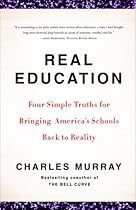
Real Education


Real Education by Charles Murray should be required reading for all education majors and teachers. It addresses some of the fundamental problems with our educational system today. It focuses on the fact that not everyone in going to excel academically, and that we shouldn’t try to force everyone too. People have different areas of strengths and we should encourage students to focus on those areas while learning basic knowledge in other areas. He believes that only the top 10 to 20 percent of students should really go to universities, because they are the only ones who really benefit from because they are the ones who want to excel academically. Other students should be encouraged to attend post-secondary vocational schools or pursue certifications. If you can pass the CPA exam after taking a few classes at a community college, why do you need a four-year degree? If you graduated from Harvard because you took all the easy classes and you can’t pass a certification to become a marketing professional, then that’s too bad. Certification programs would help level the playing ground and keep so many students from drowning in debt to attend college. The top students who would attend universities would be able to learn more because they’d be surrounded by people who want to be there learning, not just partying, and wouldn’t get made fun of for their study habits. And for students who excel at working with their hands or building things, such as mechanics or welders, encourage them to attend vo-tech during high school and let them get to work as soon as they graduate. Don’t treat them like second-class citizens or idiots because they didn’t go to college or don’t want to go to college. Don’t push them in that direction when they’d be happier and actually make more money going in to something like welding. Why do we ridicule these types of positions? Many blue collar workers can pull in $100,000 a year. Why don’t we tell high school students that? Why don’t we encourage them to pursue those fields instead of focusing only on college?
My brother hated school. Hated it. My mom would literally have to sit on him to get him to do his homework. Me, on the other hand, loved school. I’d make up assignments for myself and play school in the summers. In the years when I had crappy teachers, I couldn’t wait to get home to read and teach myself. (Yes, I was a giant nerd and still am because I totally still do that, but that’s not the point of the story.) We are very different people. I attended a great college for my BA and went on to get my MA. My brother took vo-tech classes in high school. He now has a good job, and no college debt. I don’t have college debt either, but I’m a very rare exception, especially because I went to an expensive private school. It would be feasible for me to have more student loan debt than I make in a year. For many of my classmates, that’s true. OBU cost about $16,000 when I went there (I think it’s at least 20 now). That’s $64,000 for four years. Many of my classmates majored in fields such as ministry and education. Not exactly fields known for their large incomes. How long is it going to take them to pay that money back? Was it worth it? They may have loved the experience and liked their classes, but how many of them really learned enough to make that worth it? I know from having classes with these people that it sure didn’t seem like they learned that much. Most of those people end up leaving before graduation, but how much did they spend on freshman year alone? I feel myself getting on my soap box and this post could go on for a long, long time, so I will wrap it up by saying that if you’re interested in education or are an educator or parent, read this book.

They Must Be Stopped


I read Brigette Gabriel’s Because They Hate a few years ago and loved it, and so I picked up They Must Be Stopped at the library. Because They Hate was about her life growing up in Lebanon as a Christian and the Muslim/Christian civil war that destroyed the country and resulted in her eventually coming to the U.S. She provided a lot of information about the background of Islam as well. That book was wonderful, and it was a lot stronger than They Must Be Stopped, probably because it was part memoir, part social commentary. They Must Be Stopped was good, but I felt like I already knew a lot of the information, either from reading her previous book or others books on the topic. I also had the impression that it was supposed to be more of a how-to guide to stopping the spread of Islam, and that was really confined to the last two chapters. It was a good refresher though, and it would be great for those who are unfamiliar with the topic.
Gabriel goes through a little of the history of Islam and it’s call to violence, then goes into it’s spread around the world and their plan for conquering other countries for Islam. That part was interesting, and she goes through what they are doing in specific countries.
One new thought I got from the book was regarding why so many black American men turn to Islam while in prison. I’ve always found that odd, especially since Muslims do not have high regards for blacks. Gabriel points out that in Arabic, the words for black people are the same as the ones for “slaves” and “filth.” (Arabic is Gabriel’s native language, so she’s not misinterpreting something.) Anyway, she pointed out that they target men in prison because then they can target murderers, rapists, and child molesters and say “It’s okay. Mohammed is on your side. Mohammed says that women are here for our pleasure when we want. Mohammed married a six-year-old girl and slept with her when she was nine and he was in his 50s. Islam encourages you to kill in the name of Allah. It’s okay. Join Islam and you can do these things in the name of Allah and be rewarded in Heaven.” What? Who wouldn’t want that message instead of guilt? That was eye-opening to me.
I also thought it was interesting that she gave an example of the U.S. caving to Muslims by installing foot-washing benches in the restrooms in the Kansas City International Airport, even though during her 24 years in the Middle East she never once saw a foot-washing bench in a public restroom, at airports, at universities, or at hospitals. It’s insanity the way we bend over backward for people who are trying to kill us. What is wrong with us?

Other Middle Eastern related books I really like:
Reading Lolita in Tehran by Azar Nafisi – memoir about her life in Iran during the revolution and her book club during that time (she was a professor before the revolution), absolutely fascinating, one of the best books I’ve ever read
The Truth About Mohammed by Robert Spencer – it’s about Mohammed life and what he really preached and was like
The Politically Incorrect Guide to Islam by Robert Spencer – about Islam in general, gives a great overview and meaty info in a well organized, easy to read manner
Infidel by Ayaan Hirsi Ali – a memoir about growing up in Somalia being raised as a Muslim, including being circumcised, and how she escaped to freedom and was amazed at how wonderfully non-Muslims treated her, she was a member of the Dutch parliament who worked on a film about domestic violence in the world of Islam with Theo Van Gogh before he was assassinated

Sunday, November 8, 2009

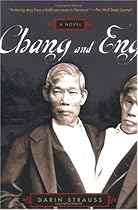
Chang and Eng


Read this book: Chang and Eng by Darin Strauss. It's one of the best books I've read in a long time. It's about a pair of conjoined twins, the ones from whom the term Siamese twins comes from. It takes place during the 1800s and goes back in forth in time from thier birth and childhood and when they are older and living in North Carolina. It's based on a true story and the main events are true, but it's a fictionalized account of their lives. It's told through the perspective of Eng. It's beautifully written, and I can't believe it was Strauss's first novel. The characters are wonderfully drawn, and he clearly separates the characters of Chang and Eng. He really makes you picture what life would be like with no privacy, to always have someone attached to you. Eng tends to retreat into his mind, I think because that's the one place he can be alone. I found it interesting that a third character seemed to appear between them, the band that connects them. It almost took on a life of it's own, made a third character of Chang-and-Eng in addition to the two separate characters.
Strauss starts with a compelling story. I've always been fascinated by and somewhat repulsed by conjoined twins. I feel bad saying that and I hate that people mistreated conjoined twins as monsters, but it just seems so wrong. I think it's also just something people don't like to think about because we can't imagine having to go through life like that. I was amazed at how strong Eng remained though, although Chang's tendency to turn toward drink is understandable as well.
I thought it was amazing that while the boys were taken by the King of Siam and used as entertainment, and eventually sold to an American to use for shows, they were never actually part of a circus, not for lack of trying on P.T. Barnum's part though. They still have both inner and outer battles over maintaining their dignity as they perform though. The later parts of the book take place against the backdrop of the War of Yankee Agression (I can't believe Strauss referred to it that way!), which highlighted Chang and Eng's own personal civil war against each other later in life. How can you not grow to resent this person who is always there, not just looking over your shoulder but practically attached to it? But as their mom says, how can you fight with someone you're physically attached to? That would be madness.
Eng also has internal battles over marriage and love. He believes it will never happen for them, but then they meet two sisters in North Carolina. The book covers the logistics of the marital bed and how awkward that is when there's a third person literally in bed with you that you're trying to pretend isn't there.
As someone who desparately needs her alone time, I cannot fathom having someone attached to me at all times. It's actually that thought that makes it hard for me to want children. But Strauss did an incredible job of creating this story and making feel like I was Eng for a time. He transported me into the mind of a Siamese conjoined twin man in the 1800s. That's impressive. So, you should absolutely go read this book. I can't wait to pick up his other two books.
Also, this books gets to count for one of my reading challenges! It has a proper name and is worth 5 points in the four-month reading challenge.

Wednesday, November 4, 2009

Countdown Reading Challenge

`
Another exciting challenge! This one will force me to read books actually written this century. The past few years I've focused heavily on reading classics. I started reading the classics beginning with the ancient Greeks and worked my way through Beowulf, at which point I switched to British only works and read my way up to Shakespeare. The last few months I've tried to just read normal books for a bit of a break. I want to continue my timeline reading, but I've missed a lot of books over the past few years so this will motivate me to catch up.
So what's the challenge? It's a Countdown Challenge. You read 10 books that come out in 2010, 9 in 2009, 8 in 2008, etc. down to 2001. This will also force me to read new books as they come out instead of buying them and letting them join my ever growing to-be-read (TBR) pile.


Total: 33/55 books

2010
1. The Weed that Strings the Hangman's Bag - Alan Bradley
2. Not My Daughter - Barbara Delinksky
3. Every Last One - Anna Quindlen
4. The Imperfectionists - Tom Rachman
5. The Language of Secrets - Dianne Dixon
6. Heart of the Matter - Emily Griffin
7.
8.
9.
10.

2009 (Done)
1.The Guinea Pig Diaries - A.J. Jacobs
2. Her Fearful Symmetry – Audrey Niffeneger
3. A Gate at the Stairs - Lorrie Moore
4. The Sweetness at the Bottom of the Pie by Alan Bradley
5. The Simpsons: An Uncensored, Unauthorized History by John Ortved
6. High Society: The Life of Grace Kelly - Donald Spoto
7. The Girl She Used to Be - David Cristofano
8. Fall to Pieces - Mary Forsberg Weiland
9. Unclutter Your Life in One Week - Erin Doland

2008 (Done)
1. Shakespeare Wrote for Money - Nick Hornby
2. Made in the U.S.A. - Billie Letts
3. The Lost Memoirs of Jane Austen - Syrie James
4. Stolen Innocence - Elissa Wall with Lisa Pulitzer (done)
5. Remember Me - Sophie Kinsella (done)
6. More Than It Hurts You by Darin Strauss (done)
7. The Man Who Invented Christmas - Les Standiford
8. The Lucky One by Nicholas Sparks

2007
1. Made from Scratch - Sandra Lee
2. The Fourth Bear - Jasper Fforde
3. French Milk - Lucy Knisley
4. Everything I Needed to Know about Being a Girl I Learned from Judy Blume
5. Big Boned - Meg Cabot
6.
7.

2006
1.
2.
3.
4.
5.
6.

2005
1. 44 Scotland Street - Alexander McCall Smith
2.
3.
4.
5.

2004
1.
2.
3.
4.

2003
1. Club Dead - Charlaine Harris
2.
3.

2002 (Done)
1. Living Dead in Dallas
2. Shopaholic Takes Manhattan - Sophie Kinsella

2001 (Done)
1. Dead Until Dark by Charlaine Harris