Saturday, January 9, 2010

The Politically Incorrect Guide to the Founding Fathers


I really enjoy the Politically Incorrect Guide series. Unlike a lot of nonfiction books, they do a good job of breaking up the copy with section headers and sidebars. Most nonfiction books have really long chapters with no sort of breaks, and while that doesn't bug me in fiction, I can usually only read a little nonfiction at a time.
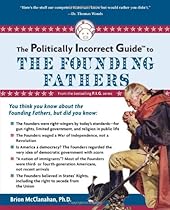
The PIG Guide to the Founding Fathers is, obviously, about about the founding fathers. Since little about most of the founding fathers is actually taught in schools these days, most people don't really know that much about even the biggest of them, and no nothing about many of the less prominent founders. This book starts with a good foundation of the myths currently told about the founders, the issues they focused on, and the revolution. Then it goes into mini-biographies of the "big 6" founders and 14 other founders.
Despite feeling like I knew a fairly decent amount of about the founders, I learned a lot, especially about the 14 other founders. I had never even heard of some of them, and yet they played large roles in the creation of my country. Some of them, like John Hancock, I had obviously heard of, but other than his famous signature I didn't know anything about him. Apparently he almost single-handedly financed the revolution. When Paul Revere made his midnight ride, he was going to warn Hancock and Patrick Henry specifically because the British were coming after them. The British believed that capturing just those two men would stop the revolution by removing their source of funding and their greatest orator. That's pretty impressive.
So historically, I highly recommend this book as a great foundation of the time. Another reason I like the PIG series is they recommend other books throughout the book, so now I have a great list of biographies of all of the founders and other books.
The other part I enjoyed about this book was that it focused heavily on the founders belief in states' rights and limited government. What so many people today don't realize is that our federal government was never supposed to be bigger or more important that the state government. Most of the founders wouldn't sign the Constitution without the Bill of Rights, most specifically the 10th amendment that guarantees the states' sovereignty in all things not listed in the Constitution, and that the federal government is limited to only the items listed in the Constitution. They would be appalled that the federal government controls the states now in almost everything. It would work so much better the way the founders wanted it to work. Then, if you had a state that wanted something like gay marriage, that state could make it legal. If a state didn't want it to be legal there, they wouldn't have to. And if a state, like Massachusetts, wants to provide healthcare to everyone, then they can. As long as they follow the laws of their state, then go right ahead. But the federal government has no right to force any state to participate in a healthcare program (or punish those who don't participate) or tell them they have to make gay marriage legal or illegal. That's why I'm a libertarian. Both parties have serious issues with this. Both of them have pushed various issues at the federal level when they shouldn't. Using the two examples I've mentioned, the Democrats are pushing federal healthcare right now, and Republicans have pushed for a national marriage amendment to outlaw gay marriage. Regardless of how I feel about either of those things, both are wrong at the federal level. At the state level it's different.
Sorry to get on a political tangent there, but I just get so frustrated with all of our politicians today, and it was both enjoyable and frustrating to read about a whole book of people I actually agree with. It made me feel like I was born in the wrong time period, except for the whole electricity and indoor plumbing and birth control thing!

Tuesday, January 5, 2010

A Tournament of Reading Challenge


Okay, I'm joining another challenge, the Tournament of Reading challenge. Since I'm already going to read the History of the Medieval World by Susan Wise Bauer, and I'd like to try rereading the Divine Comedy, that's two of the three books needed for the peasant level, so surely I can at least reach that right?

The Lord of the Rings Read-a-Long


I've been wanting to join/start a book club for a while, but since I'm too lazy to actually leave the house in the evenings, an online read-a-long is perfect! Eva, Teresa, Clare, and Maree are hosting a Lord of the Rings read-a-long over the next four months.

To kick it off, I'm answering Eva's discussion starters as an introduction.

When did you first hear of The Hobbit?
Elementary school. I didn't read fantasy then though. I stayed away from all things fantasy - Narnia, Tolkien, even Roald Dahl, - until Harry Potter came into my life in 1999, my senior year of high school. I dove into all the fantasy I missed then and through college.

What made you decide to join the read-a-long?
Eva's post warmed me up, then reading Teresa's post made me remember why I liked the books. I also like the idea of a sort of online book club, so I'm not just posting reviews into cyberland, but am part of a community.

Have you read it before? If so tell us about that experience.
Yes, just once, in college. I took a colloquial honors class on the LOTR the semester before the first LOTR film came out. We read all the books. My then boyfriend, now husband had been encouraging me to read them, so we took the class together with a bunch of nerds. It was awesome. I loved the Hobbit, and I loved parts of the LOTR, but I have to admit I got waded down in all the descriptions. Normally, I like that sort of thing, but the battle scenes just dragged on. Over the years I've started remembering only the negative, and reading Teresa's post reminded me why I did actually like the books, so I decided to reread them.

If you’re new to The Hobbit, do you have any preconceptions going into it? N/A

J.R.R. Tolkien pretty much founded the modern fantasy genre. So let’s take a moment to think about the genre as a whole; have you always loved fantasy? Or perhaps you still feel rather skeptical towards the whole idea of wizards and dwarfs and magic What was your introduction to the genre?
I answered this in the first question. I still don't read a lot of fantasy, usually just the popular stuff like Narnia, LOTR, and Harry Potter. I am completely obsessed with Harry though. I've been Hermione several times for Halloween and reread the books pretty much every year.

Do you have a certain plan for reading it? A few pages a day, spacing it out over the month? Or are you just going to race through it? Let whimsy decide?
I will probably start it this weekend and go slowly, although I'll probably end up reading the Hobbit pretty quickly. But if I could get a little ahead so I can read The Two Towers in small pieces that would probably be good. That's where I kept getting stuck when I read them the first time.

French Milk

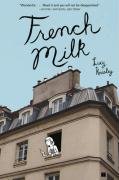
I was disappointed when I received French Milk by Lucy Knisley in the mail. I had ordered it online and Amazon neglected to call it a graphic novel. The official review on the page mentioned it had photos and sketches, but I thought that would be in addition to the story, not the whole story. So, I wasn't very happy with this purchase. I'm not a big graphic novel fan. I did love Watchmen, but I've tried a few others but I just can't get used to the format. I tend to want to ignore the photos, which you can't do. So, take this review with a grain of salt.
Although the book was enjoyable, I felt like it lacked substance. There just wasn't any meat to it. I thought I would get to delve into life in Paris for a month, and Lucy's relationship with her mother. But it just skims the surface. And most of that surface involves smoking and drinking. She took up smoking just because she was going to Paris? Really? I also just found Lucy to be a bit annoying. I wanted to slap her upside the head and tell her "You're in Paris!!! Enjoy it! Quit whining!" She even tells herself that at some point.
Even though I'm being really negative, I do see how some people would enjoy it. If you know going in that it's a graphic novel, and don't expect to get travel tips from it, then you may actually enjoy it. And the cover is really pretty, so it looks nice on my shelf, which makes me feel a little bit better about the money I spent on it. I'd suggest getting it from the library instead of purchasing it.

Teaser Tuesdays


I decided to try out Teaser Tuesdays, hosted by MizB of Should Be Reading.
I'm currently reading The Politically Incorrect Guide to The Founding Fathers by Brion McClanahan. Here's my teaser:
"Lee conceded that parts of the Constitution were sound, but without a bill of rights and strict limitations on government, the people would be subject to the worst evils of power."
Sorry to burst your bubble Richard Henry Lee, but the bill of rights and the 10th amendment didn't save us from that. As a libertarian, I'm appalled by the insane growth of government that BOTH Obama and Bush are doing/have done. It's crazy. I can't imagine what the founders would think today. Too bad we don't appreciate their ideas and distrust of government and emphasis on state government. The teaser did make me excited to get to the chapter on Lee though.

Saturday, January 2, 2010

The Fourth Bear


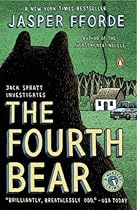
The Fourth Bear by Jasper Fforde is the second in his nursery crimes series. Although I prefer his Thursday Next series, I enjoyed this book a lot, and thought it was better than The Big Over Easy, the first nursery crimes book. I read recently that was actually his first book, it just didn't get published until after the Thursday Next books, which explains a lot. He rewrote most of it before it was published, but you can still tell it's not as polished as the Thursday Next series.
Anyway, The Fourth Bear has anthropomorphized bears, Goldilocks, Dorian Gray the car salesman, the Gingerbreadman serial killer (literally a gingerbread man), and nuclear cucumbers. Yeah, it was awesome. Fforde's books are just so fun to read because you never know what's going to happen or who might appear. I'll never look at gingerbread the same way again.
As for the nuclear cucumbers, Fforde got his inspiration for that from Jonathan Swift! I did a lot of research on Swift when I was working on my thesis for my master's of arts in English, but then I decided to just do the test option instead since I was working full-time at a job that required a lot of writing and I'd already written one thesis for my undergrad degree. Anyway, I have a softspot for all things Swift. In Gulliver's Travels, on Laputa, Gulliver meets someone who has been working to extract sunbeams from cucumbers, which sparked Fforde's idea for the plot. It made me want to reread Gulliver's Travels again, so I may have to add that to my Flashback challenge reading list.
This was a good pick for my first book of the new year. It's fun, eccentric, a fast-read, and entertaining. As long as you like quirky books, I recommend giving this one a try.

My Favorite Books Read in 2009

Here is my top 10 list of my favorite fiction books I read this year and my top 5 non-fiction books. I tried to stick with just the books I read since starting my blog in April, although I included one from earlier because I did read his other two books after I started blogging, and the first one was definitely his best so I wanted to list it.

Best Fiction
1. The Girl Who Stopped Swimming by Joshilyn Jackson
2. The Sweetness at the Bottom of the Pie by Alan Bradley
3. Chang and Eng by Darin Strauss
4. Rereading all of Harry Potter
5. The Patron Saint of Liars by Ann Patchett
6. The Last Dickens by Matthew Pearl
7. Handle with Care by Jodi Piccoult
8. Those Who Save Us by Jenna Blum
9. Atonement by Ian McEwan
10. Heartburn by Nora Ephron

Best Non-fiction
1. The Know It All by A.J. Jacobs (read before I started blogging)
2. Stolen Innocence by Alissa Wall
3. Arguing with Idiots by Glenn Beck
4. Two Princes by Alison Weir
5. Real Education by Charles Murray