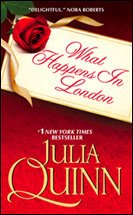
 I know romance novels aren't the most literary things in the world, but they are great for a nice break. And I love Julia Quinn. She's intelligent (she went to Harvard!), she writes well, she creates lovable characters, her books actually have a story, she writes more realistic sex scenes than most authors period (seriously), and she's funny. That said, What Happens in London isn't her best book. It's still good, and I still enjoyed it, but it just didn't draw me in the same her Bridgerton series or most of her other books do. I'm not sure what it was. It definitely picked up by the end, and I caught myself wandering around the house brushing my teeth and fixing dinner with it in my hand (hmmm...that's probably why I'm not the most outstanding cook in the world), but it had a slower start than usual. I think it was because there wasn't any suspense about the two characters. She tried to create mystery around Harry, but since we see things from his point of view early on we know he's a good guy. I think that was the problem. But Julia Quinn on a bad day is far superior to most romance novelists on their best days.
Wednesday, November 4, 2009
What Happens in London...
I know romance novels aren't the most literary things in the world, but they are great for a nice break. And I love Julia Quinn. She's intelligent (she went to Harvard!), she writes well, she creates lovable characters, her books actually have a story, she writes more realistic sex scenes than most authors period (seriously), and she's funny. That said, What Happens in London isn't her best book. It's still good, and I still enjoyed it, but it just didn't draw me in the same her Bridgerton series or most of her other books do. I'm not sure what it was. It definitely picked up by the end, and I caught myself wandering around the house brushing my teeth and fixing dinner with it in my hand (hmmm...that's probably why I'm not the most outstanding cook in the world), but it had a slower start than usual. I think it was because there wasn't any suspense about the two characters. She tried to create mystery around Harry, but since we see things from his point of view early on we know he's a good guy. I think that was the problem. But Julia Quinn on a bad day is far superior to most romance novelists on their best days.


Four-Month Reading Challenge
Okay, so I knew this reading challenge thing was going to suck me in. I've signed up for two more challenges. They both allow crossovers from other challenges, so I might be able to count some books for both challenges, but I'm not going to go out of my way to do that.
The first challenge is a four-month challenge running from Nov. 1, 2009 to Feb. 28, 2010.
Here's the challenge, and a few books I've plugged in that are already on my to-be-read list or things that came to me as I looked at the categories. I'm such a nerd. I can't believe I'm this happy about discovering these things.
5 Point Challenges
Read a book with a proper name in the title – Chang and Eng by Darin Strauss
Read a book about a queen or king – The Six Wives of Henry VIII by Alison Weir
Read a book by or about/related to a Bronte
Read a book about Vampires - Dead Until Dark by Charlaine Harris
Read a book by V.C. Andrews – Flowers in the Attic
10 Point Challenges
Read a book by Canadian author – The Sweetness at the Bottom of the Pie
Read a book by or about/related to Charles Dickens - The Man Who Invented Christmas
Read a book set in France - French Milk by Lucy Knisley
Read a book by Georgette Heyer
Read an ‘art’ themed book. – The Girl with the Pearl Earring
15 Point Challenges
Read a book with a Civil War theme (any country) The Killer Angels
Read a book with characters inspired by King Arthur or about King Arthur/Camelot – The Crystal Cave
Read a biography/autobiography – Stolen Innocence by Elissa Walls
Read a book related to or something by Shakespeare –
Read a book by an author born in November, December, January or February – Mrs. Dalloway by Virginia Woolf, born Jan. 25
20 Point Challenges
Read a book with a wintery theme (Christmas, snow, ice, freezing, star, camel, mistletoe, etc.)A Christmas Carol
Read a book that was a winner of the Pulitzer Prize for Fiction – Olive Kitteridge by Elizabeth Strout
Read a book that begins with A and one that begins with Z - Arguing with Idiots and
Read a book from The Modern Library Top 100 – To the Lighthouse by Virginia Woolf
Read a book and then write a review – The Guinea Pig Diaries by A.J. Jacobs
160/250 points
Tuesday, November 3, 2009
Reading Challenges!
Uh oh. I think I found a new addiction. Reading challenges. This could be bad. Or really awesome. Apparently there are a lot of reading challenges on book blogs, where people sign up for a challenge to read certain books or types of books or books by certain authors, etc., then they blog about them. Fun! I'm starting slow with a mini-challenge about Wilkie Collins. I just have to read two Wilki Collins' books by Dec. 1. I'm going to read The Woman in White and The Lady and the Law. I bought The Woman in White when I was working on my Master's degree, and we ended up not reading it in the class I bought it for, 19th-century British literature. It was an awesome class though. We read four Dickens' novels in serial format (we started all four at the beginning of the semester and finished them at the end). We also read quite a few other things, and I absolutely loved that class, and trying to read in serial format was my favorite part. It was hard to not read ahead, especially in Bleak House, which ended up being not only my favorite book from that class, but one of my top favorite books of all time. Anyway, I've always meant to go back and read The Woman in White because it sounded really good, but I just haven't gotten around to it.This challenge is a great motivation, plus I read a review of The Lady and the Law on the Wilkie Collins blog tour (which is a totally awesome concept and yet another addicting item - when am I going to have time to read novels if I can't stop reading these blogs???).
Wednesday, October 28, 2009
The Lost Symbol

Like The DaVinci Code and Angels and Demons, The Lost Symbol is action packed and a quick, thrilling read. I still like Angels and Demons the best out of the three, although I really enjoyed The Lost Symbol as well. The Lost Symbol and Angels and Demons are clearly easier to read and enjoy as a Christian since The DaVinci Code has quite obvious problems that take away from the experience even though I still enjoyed the book. The Lost Symbol is not anywhere close to being as controversial, and actually may be more controversial in the fact that he doesn't attack the Masons instead of attacking them. He seems to have come to appreciate the Masons and their support for learning and knowledge. The plot centered around ancient knowledge and how we use so little of our brain power. This is tied to something called noetic theory, which is a theory about using our brain power and intellect to it's fullest potential and researches things like using your mind to change matter and if we have a soul. It sounds completed insane at first in the book, but then it all starts to actually sound really intriguing and made me want to read more about it. One of the items they research is the power of prayer and how having a large group of people focus on something mentally can actually influence outcomes. The day after I read that, I was in a training class where we all discussed how this client wasn't calling back one of our sales reps and then when we broke for lunch he checked his messages and the client had called right after we had that discussion. It was probably just a coincidence, but it was interesting nonetheless.
I also enjoyed that the book took place in D.C. Since I've been to most of the places in the book, that made it seem more real. I felt like it started a little slow, or maybe it started fine but then dropped off a bit before picking back up. I still read the whole thing pretty quickly, but I wasn't in that can't-put-it-down type of place the whole time. I definitely got there by the end, which was extremely suspenseful and terrifying, but something happened around the second quarter of the book where I just wasn't as focused. Still a good read overall, but that made Angels and Demons better in my opinion.
P.S. It makes me laugh that when I did a Google Images search for The Lost Symbol, the Dharma logo from Lost came up. How funny is that? It's the Lost symbol!
Reading About Readers
I read this blog post today about reading about characters who like to read. I always like when I come across a character who reads, and this blog post happened to point out four books that I've read and liked: Jane Eyre, David Copperfield, The Age of Innocence, and Madame Bovary. Another one that jumps out to me is Catherine in Northhanger Abbey by Jane Austen. That book actually is much better when you read it in context of Catherine being a big reader of gothic novels. The first time I read it around sophomore year of high school, I didn't get it. I didn't like Catherine and thought she overreacted to everything. Which she does, but she's basically trying to be a herione like in one of her precious novels, which makes it all much more understandable. It also makes more sense to know Austen was mocking gothic novels. Since reading it the second time in college with that understanding (thank you Dr. Gerard!), I not only now find this book to be hilarious, I also read more carefully when I notice a character reading.
Tuesday, October 27, 2009
The Year of Living Biblically

I love A.J. Jacobs. I read The Know-It All in January and just loved the way he writes. He made a book about reading the Encyclopedia Brittantica interesting and funny. He just seems like he'd be a cool, although somewhat odd, guy to hang out with. For The Know-It All, he chronicled his year he spent reading the EB. For The Year of Living Biblically, he spent a year following the Bible literally. I was a little nervous about this one because I was afraid he was doing this to try to show how silly the Bible is and poke fun of Christians. That was fortunately not the case. The thing about A.J. that I like is that he just seems to like learning, so he enjoyed the experience of learning more about the Bible and religion in general rather than trying to promote a cause. It was also interesting that one of the reasons he wanted to pursue this topic was because of his son. He didn't want to raise his son to be without religion, without a moral compass. I find it odd that he doesn't want his son to be an agnostic even though he's one. A.J. is also a secular Jew, so that added to the interesting aspects of the book to see him digging into his family history and also made his lack of conversion make a little more sense to me.
Anyway, the book itself is just fascinating. He grows a beard that he can't trim. He wears white clothes. He avoids touching women in general since it might be the time of the month where they are unclean. He takes a seat with him at all times to keep from sitting on soiled ground. He travels to Israel. He attends Jewish religious festivals. He talks to evangelicals and visits a creationism museum. And even though he doesn't believe in creationism, he doesn't mock it either. He talks about how intelligent the scientists there are. He's truly open in a way very few people are. He lets himself experience being in the moment of whereever he is, trying to see others' rituals and beliefs through their eyes. He's still too liberal for me, but then pretty much everyone is.
Summary of why you should read this book: it's funny, entertaining, and enlightening. It made me want to learn more about my religion and dig deeper in the Bible. I learned things I didn't know, both about the Jewish faith and my own.
Monday, October 26, 2009
In-N-Out Burger

In-N-Out Burger by Stacy Perman reads more like a biography than a business book. The intro is wonderful, but then next few chapters focus a little too much on the parents of the founders and their family history. A little bit of background into their family is essential in this story, but it just took a few chapters to even get to the founding on In-N-Out. From there, the story was wonderful, although I kept getting hungrier with every page. Don’t read this on an empty stomach! My mouth started watering during the intro, so much so that I started contemplating the drive to Arizona.
The book starts off talking about the massive lines when they opened the location in Tucson. People showed up during the night before the opening to wait. They piled into the store in lines 7-8 people wide and hundreds deep. Cars snaked around the block. They set up a trailer in the parking lot to have two kitchens and even that couldn’t help keep up with the demand. But the employees kept smiling, service never wavered, and everyone left happy. The heart of this book is how do you create a brand like that? But, it tells the story in a unique way. It follows the advice of fiction writers and shows people how to do this instead of telling them the top 10 ways to build a brand or something like typical business book would do. It made for more interesting reading this way.
One of the key ways In-N-Out built such a huge following is the way they take care of their employees. Even from the beginning, well before such things were taught in any business school, they called their employees “associates” and paid them well over the minimum wage. They also paid them bonuses in savings bonds at Christmas. The Snyders knew that treating their employees with respect wasn’t just the humane and Christian way to do things, but it was also good for business. Keep your employees happy and smiling, and they’ll keep your customers happy and smiling. It’s that simple. You don’t need a fancy business degree to see the truth in that. This book reminded me of how much we overcomplicate things sometimes. Just treat others well and provide a quality service or product. It’s not that complicated. It’s not necessarily easy, but it’s not complicated. You don’t need Six Sigma and fancy customer service systems. You just need common sense, something that most people seem to lack these days.
I became very interested in the story of Rich Snyder (one of the founders' sons) and was sad about his death. He was giving, not only to charities but to employees. He paid for any employee to adopt a child if they couldn't have children, and paid for the adoption costs for a friend as well. Can you imagine being able to help people that way? He was also the one who put the Bible verses on their cups. It will be interesting to see how things play out for the restaurant as Lynsi (granddaughter of the founders and sole heir) takes over. She's my age! I can't imagine having that opportunity or that pressure from such a young age. She's been the sole heir since high school. Crazy.
Subscribe to:
Posts (Atom)