Monday, November 9, 2009

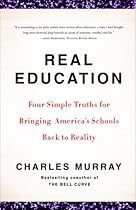
Real Education


Real Education by Charles Murray should be required reading for all education majors and teachers. It addresses some of the fundamental problems with our educational system today. It focuses on the fact that not everyone in going to excel academically, and that we shouldn’t try to force everyone too. People have different areas of strengths and we should encourage students to focus on those areas while learning basic knowledge in other areas. He believes that only the top 10 to 20 percent of students should really go to universities, because they are the only ones who really benefit from because they are the ones who want to excel academically. Other students should be encouraged to attend post-secondary vocational schools or pursue certifications. If you can pass the CPA exam after taking a few classes at a community college, why do you need a four-year degree? If you graduated from Harvard because you took all the easy classes and you can’t pass a certification to become a marketing professional, then that’s too bad. Certification programs would help level the playing ground and keep so many students from drowning in debt to attend college. The top students who would attend universities would be able to learn more because they’d be surrounded by people who want to be there learning, not just partying, and wouldn’t get made fun of for their study habits. And for students who excel at working with their hands or building things, such as mechanics or welders, encourage them to attend vo-tech during high school and let them get to work as soon as they graduate. Don’t treat them like second-class citizens or idiots because they didn’t go to college or don’t want to go to college. Don’t push them in that direction when they’d be happier and actually make more money going in to something like welding. Why do we ridicule these types of positions? Many blue collar workers can pull in $100,000 a year. Why don’t we tell high school students that? Why don’t we encourage them to pursue those fields instead of focusing only on college?
My brother hated school. Hated it. My mom would literally have to sit on him to get him to do his homework. Me, on the other hand, loved school. I’d make up assignments for myself and play school in the summers. In the years when I had crappy teachers, I couldn’t wait to get home to read and teach myself. (Yes, I was a giant nerd and still am because I totally still do that, but that’s not the point of the story.) We are very different people. I attended a great college for my BA and went on to get my MA. My brother took vo-tech classes in high school. He now has a good job, and no college debt. I don’t have college debt either, but I’m a very rare exception, especially because I went to an expensive private school. It would be feasible for me to have more student loan debt than I make in a year. For many of my classmates, that’s true. OBU cost about $16,000 when I went there (I think it’s at least 20 now). That’s $64,000 for four years. Many of my classmates majored in fields such as ministry and education. Not exactly fields known for their large incomes. How long is it going to take them to pay that money back? Was it worth it? They may have loved the experience and liked their classes, but how many of them really learned enough to make that worth it? I know from having classes with these people that it sure didn’t seem like they learned that much. Most of those people end up leaving before graduation, but how much did they spend on freshman year alone? I feel myself getting on my soap box and this post could go on for a long, long time, so I will wrap it up by saying that if you’re interested in education or are an educator or parent, read this book.

They Must Be Stopped


I read Brigette Gabriel’s Because They Hate a few years ago and loved it, and so I picked up They Must Be Stopped at the library. Because They Hate was about her life growing up in Lebanon as a Christian and the Muslim/Christian civil war that destroyed the country and resulted in her eventually coming to the U.S. She provided a lot of information about the background of Islam as well. That book was wonderful, and it was a lot stronger than They Must Be Stopped, probably because it was part memoir, part social commentary. They Must Be Stopped was good, but I felt like I already knew a lot of the information, either from reading her previous book or others books on the topic. I also had the impression that it was supposed to be more of a how-to guide to stopping the spread of Islam, and that was really confined to the last two chapters. It was a good refresher though, and it would be great for those who are unfamiliar with the topic.
Gabriel goes through a little of the history of Islam and it’s call to violence, then goes into it’s spread around the world and their plan for conquering other countries for Islam. That part was interesting, and she goes through what they are doing in specific countries.
One new thought I got from the book was regarding why so many black American men turn to Islam while in prison. I’ve always found that odd, especially since Muslims do not have high regards for blacks. Gabriel points out that in Arabic, the words for black people are the same as the ones for “slaves” and “filth.” (Arabic is Gabriel’s native language, so she’s not misinterpreting something.) Anyway, she pointed out that they target men in prison because then they can target murderers, rapists, and child molesters and say “It’s okay. Mohammed is on your side. Mohammed says that women are here for our pleasure when we want. Mohammed married a six-year-old girl and slept with her when she was nine and he was in his 50s. Islam encourages you to kill in the name of Allah. It’s okay. Join Islam and you can do these things in the name of Allah and be rewarded in Heaven.” What? Who wouldn’t want that message instead of guilt? That was eye-opening to me.
I also thought it was interesting that she gave an example of the U.S. caving to Muslims by installing foot-washing benches in the restrooms in the Kansas City International Airport, even though during her 24 years in the Middle East she never once saw a foot-washing bench in a public restroom, at airports, at universities, or at hospitals. It’s insanity the way we bend over backward for people who are trying to kill us. What is wrong with us?

Other Middle Eastern related books I really like:
Reading Lolita in Tehran by Azar Nafisi – memoir about her life in Iran during the revolution and her book club during that time (she was a professor before the revolution), absolutely fascinating, one of the best books I’ve ever read
The Truth About Mohammed by Robert Spencer – it’s about Mohammed life and what he really preached and was like
The Politically Incorrect Guide to Islam by Robert Spencer – about Islam in general, gives a great overview and meaty info in a well organized, easy to read manner
Infidel by Ayaan Hirsi Ali – a memoir about growing up in Somalia being raised as a Muslim, including being circumcised, and how she escaped to freedom and was amazed at how wonderfully non-Muslims treated her, she was a member of the Dutch parliament who worked on a film about domestic violence in the world of Islam with Theo Van Gogh before he was assassinated

Sunday, November 8, 2009

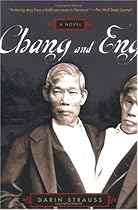
Chang and Eng


Read this book: Chang and Eng by Darin Strauss. It's one of the best books I've read in a long time. It's about a pair of conjoined twins, the ones from whom the term Siamese twins comes from. It takes place during the 1800s and goes back in forth in time from thier birth and childhood and when they are older and living in North Carolina. It's based on a true story and the main events are true, but it's a fictionalized account of their lives. It's told through the perspective of Eng. It's beautifully written, and I can't believe it was Strauss's first novel. The characters are wonderfully drawn, and he clearly separates the characters of Chang and Eng. He really makes you picture what life would be like with no privacy, to always have someone attached to you. Eng tends to retreat into his mind, I think because that's the one place he can be alone. I found it interesting that a third character seemed to appear between them, the band that connects them. It almost took on a life of it's own, made a third character of Chang-and-Eng in addition to the two separate characters.
Strauss starts with a compelling story. I've always been fascinated by and somewhat repulsed by conjoined twins. I feel bad saying that and I hate that people mistreated conjoined twins as monsters, but it just seems so wrong. I think it's also just something people don't like to think about because we can't imagine having to go through life like that. I was amazed at how strong Eng remained though, although Chang's tendency to turn toward drink is understandable as well.
I thought it was amazing that while the boys were taken by the King of Siam and used as entertainment, and eventually sold to an American to use for shows, they were never actually part of a circus, not for lack of trying on P.T. Barnum's part though. They still have both inner and outer battles over maintaining their dignity as they perform though. The later parts of the book take place against the backdrop of the War of Yankee Agression (I can't believe Strauss referred to it that way!), which highlighted Chang and Eng's own personal civil war against each other later in life. How can you not grow to resent this person who is always there, not just looking over your shoulder but practically attached to it? But as their mom says, how can you fight with someone you're physically attached to? That would be madness.
Eng also has internal battles over marriage and love. He believes it will never happen for them, but then they meet two sisters in North Carolina. The book covers the logistics of the marital bed and how awkward that is when there's a third person literally in bed with you that you're trying to pretend isn't there.
As someone who desparately needs her alone time, I cannot fathom having someone attached to me at all times. It's actually that thought that makes it hard for me to want children. But Strauss did an incredible job of creating this story and making feel like I was Eng for a time. He transported me into the mind of a Siamese conjoined twin man in the 1800s. That's impressive. So, you should absolutely go read this book. I can't wait to pick up his other two books.
Also, this books gets to count for one of my reading challenges! It has a proper name and is worth 5 points in the four-month reading challenge.

Wednesday, November 4, 2009

Countdown Reading Challenge

`
Another exciting challenge! This one will force me to read books actually written this century. The past few years I've focused heavily on reading classics. I started reading the classics beginning with the ancient Greeks and worked my way through Beowulf, at which point I switched to British only works and read my way up to Shakespeare. The last few months I've tried to just read normal books for a bit of a break. I want to continue my timeline reading, but I've missed a lot of books over the past few years so this will motivate me to catch up.
So what's the challenge? It's a Countdown Challenge. You read 10 books that come out in 2010, 9 in 2009, 8 in 2008, etc. down to 2001. This will also force me to read new books as they come out instead of buying them and letting them join my ever growing to-be-read (TBR) pile.


Total: 33/55 books

2010
1. The Weed that Strings the Hangman's Bag - Alan Bradley
2. Not My Daughter - Barbara Delinksky
3. Every Last One - Anna Quindlen
4. The Imperfectionists - Tom Rachman
5. The Language of Secrets - Dianne Dixon
6. Heart of the Matter - Emily Griffin
7.
8.
9.
10.

2009 (Done)
1.The Guinea Pig Diaries - A.J. Jacobs
2. Her Fearful Symmetry – Audrey Niffeneger
3. A Gate at the Stairs - Lorrie Moore
4. The Sweetness at the Bottom of the Pie by Alan Bradley
5. The Simpsons: An Uncensored, Unauthorized History by John Ortved
6. High Society: The Life of Grace Kelly - Donald Spoto
7. The Girl She Used to Be - David Cristofano
8. Fall to Pieces - Mary Forsberg Weiland
9. Unclutter Your Life in One Week - Erin Doland

2008 (Done)
1. Shakespeare Wrote for Money - Nick Hornby
2. Made in the U.S.A. - Billie Letts
3. The Lost Memoirs of Jane Austen - Syrie James
4. Stolen Innocence - Elissa Wall with Lisa Pulitzer (done)
5. Remember Me - Sophie Kinsella (done)
6. More Than It Hurts You by Darin Strauss (done)
7. The Man Who Invented Christmas - Les Standiford
8. The Lucky One by Nicholas Sparks

2007
1. Made from Scratch - Sandra Lee
2. The Fourth Bear - Jasper Fforde
3. French Milk - Lucy Knisley
4. Everything I Needed to Know about Being a Girl I Learned from Judy Blume
5. Big Boned - Meg Cabot
6.
7.

2006
1.
2.
3.
4.
5.
6.

2005
1. 44 Scotland Street - Alexander McCall Smith
2.
3.
4.
5.

2004
1.
2.
3.
4.

2003
1. Club Dead - Charlaine Harris
2.
3.

2002 (Done)
1. Living Dead in Dallas
2. Shopaholic Takes Manhattan - Sophie Kinsella

2001 (Done)
1. Dead Until Dark by Charlaine Harris

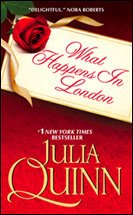
What Happens in London...

I know romance novels aren't the most literary things in the world, but they are great for a nice break. And I love Julia Quinn. She's intelligent (she went to Harvard!), she writes well, she creates lovable characters, her books actually have a story, she writes more realistic sex scenes than most authors period (seriously), and she's funny. That said, What Happens in London isn't her best book. It's still good, and I still enjoyed it, but it just didn't draw me in the same her Bridgerton series or most of her other books do. I'm not sure what it was. It definitely picked up by the end, and I caught myself wandering around the house brushing my teeth and fixing dinner with it in my hand (hmmm...that's probably why I'm not the most outstanding cook in the world), but it had a slower start than usual. I think it was because there wasn't any suspense about the two characters. She tried to create mystery around Harry, but since we see things from his point of view early on we know he's a good guy. I think that was the problem. But Julia Quinn on a bad day is far superior to most romance novelists on their best days.

Four-Month Reading Challenge

Okay, so I knew this reading challenge thing was going to suck me in. I've signed up for two more challenges. They both allow crossovers from other challenges, so I might be able to count some books for both challenges, but I'm not going to go out of my way to do that.
The first challenge is a four-month challenge running from Nov. 1, 2009 to Feb. 28, 2010.

Here's the challenge, and a few books I've plugged in that are already on my to-be-read list or things that came to me as I looked at the categories. I'm such a nerd. I can't believe I'm this happy about discovering these things.

5 Point Challenges
Read a book with a proper name in the title – Chang and Eng by Darin Strauss
Read a book about a queen or king – The Six Wives of Henry VIII by Alison Weir
Read a book by or about/related to a Bronte
Read a book about Vampires - Dead Until Dark by Charlaine Harris
Read a book by V.C. Andrews – Flowers in the Attic
10 Point Challenges
Read a book by Canadian author – The Sweetness at the Bottom of the Pie
Read a book by or about/related to Charles Dickens - The Man Who Invented Christmas
Read a book set in France - French Milk by Lucy Knisley
Read a book by Georgette Heyer
Read an ‘art’ themed book. – The Girl with the Pearl Earring
15 Point Challenges
Read a book with a Civil War theme (any country) The Killer Angels
Read a book with characters inspired by King Arthur or about King Arthur/Camelot – The Crystal Cave
Read a biography/autobiography – Stolen Innocence by Elissa Walls
Read a book related to or something by Shakespeare –
Read a book by an author born in November, December, January or February – Mrs. Dalloway by Virginia Woolf, born Jan. 25
20 Point Challenges
Read a book with a wintery theme (Christmas, snow, ice, freezing, star, camel, mistletoe, etc.)A Christmas Carol
Read a book that was a winner of the Pulitzer Prize for Fiction – Olive Kitteridge by Elizabeth Strout
Read a book that begins with A and one that begins with Z - Arguing with Idiots and
Read a book from The Modern Library Top 100 – To the Lighthouse by Virginia Woolf
Read a book and then write a review – The Guinea Pig Diaries by A.J. Jacobs

160/250 points

Tuesday, November 3, 2009

Reading Challenges!

Uh oh. I think I found a new addiction. Reading challenges. This could be bad. Or really awesome. Apparently there are a lot of reading challenges on book blogs, where people sign up for a challenge to read certain books or types of books or books by certain authors, etc., then they blog about them. Fun! I'm starting slow with a mini-challenge about Wilkie Collins. I just have to read two Wilki Collins' books by Dec. 1. I'm going to read The Woman in White and The Lady and the Law. I bought The Woman in White when I was working on my Master's degree, and we ended up not reading it in the class I bought it for, 19th-century British literature. It was an awesome class though. We read four Dickens' novels in serial format (we started all four at the beginning of the semester and finished them at the end). We also read quite a few other things, and I absolutely loved that class, and trying to read in serial format was my favorite part. It was hard to not read ahead, especially in Bleak House, which ended up being not only my favorite book from that class, but one of my top favorite books of all time. Anyway, I've always meant to go back and read The Woman in White because it sounded really good, but I just haven't gotten around to it.This challenge is a great motivation, plus I read a review of The Lady and the Law on the Wilkie Collins blog tour (which is a totally awesome concept and yet another addicting item - when am I going to have time to read novels if I can't stop reading these blogs???).